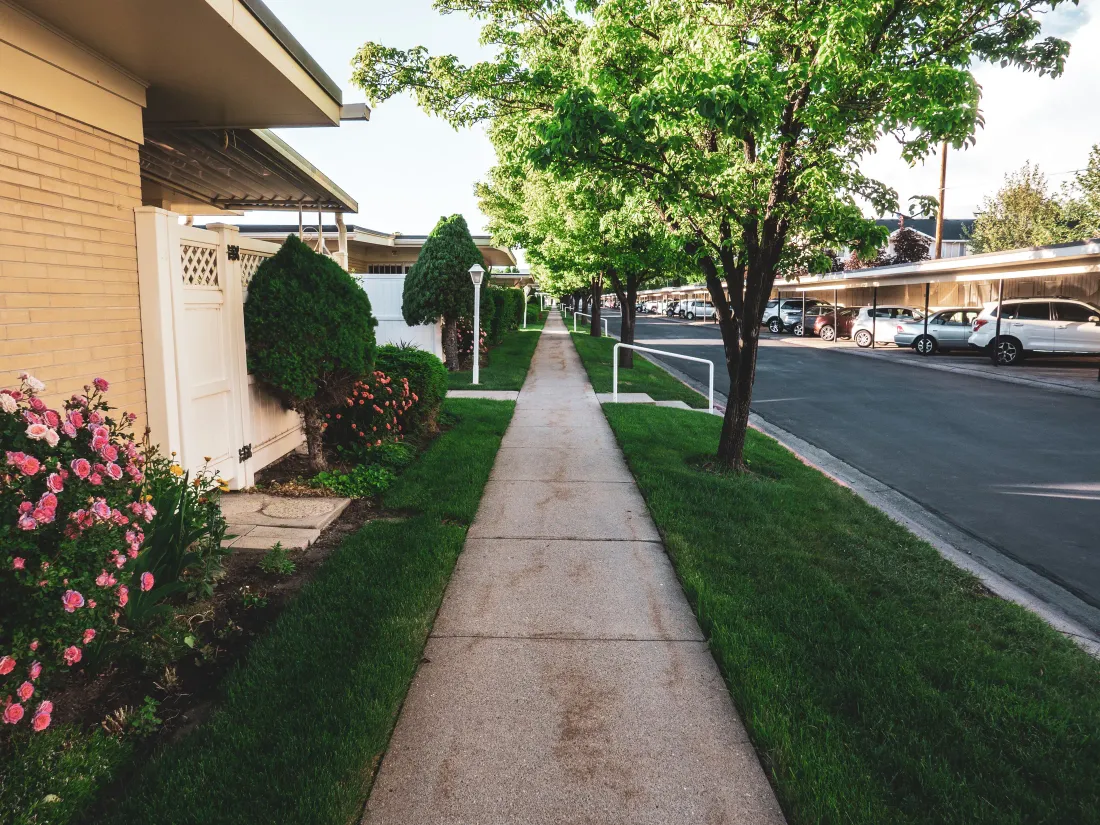
Street tree or private tree? Start here.
Modesto's published tree-removal process is built around City-owned street trees: trees in the parking strip or public right-of-way fronting a property. That is usually the strip between the sidewalk and the curb. The City's Community Forestry Division handles removal requests for those trees, and the City's Approved Tree Vendor List controls who is allowed to work on them.
A tree inside your fence line, in your back yard, or anywhere else fully on your own parcel is a private tree. Everything the City currently publishes on its Tree Removals page is about the street-tree program; it does not describe a permit for removing a private tree. That is not the same as the City saying no permit is ever needed — see the honest caveat two sections down.
If you're not sure which one you have, the tree's position relative to the sidewalk is the usual tell, and the Forestry Division can confirm. Don't guess: removing a City tree without going through the City is the kind of mistake that gets expensive.
City street trees: how the Modesto process works
-
Confirm it is a street tree
City street trees are the ones in the parking strip or public right-of-way fronting your property — typically between the sidewalk and the curb. A tree inside your fence line or in your back yard is a private tree and follows a different path (see below).
-
Submit the request to the City
Use the City of Modesto Tree Removals page (modestogov.com/362/Tree-Removals) or the CitySourced resident-request portal. The Community Forestry Division handles these — 209-342-2253 direct, or the City general line at 209-577-5200.
-
Expect to pay for removal and replacement
Under the City's program the property owner is financially responsible for the cost of removing a City street tree and for replacing it. If a replacement tree isn't planted, the owner is charged the cost of a 24-inch boxed replacement tree instead.
-
Use an approved vendor for the work
The City maintains an Approved Tree Vendor List (modestogov.com/2342) of companies it allows to perform work on City trees. Being on the list is about who may do the work on a City tree — it is not itself a permit, and it isn't required for a private tree.
The two numbers the City publishes
Two size figures show up in the City's material, and they're worth reading precisely because they get repeated loosely elsewhere. First, a street tree under 6 inches in diameter, measured 4.5 feet above the ground, may be eligible for removal under permit procedures in specific contexts — the example the City gives is a driveway-widening project. Second, if a replacement tree isn't planted after a removal, the owner is charged the cost of a 24-inch boxed replacement tree. Neither figure is published as a general "trees bigger than X need a permit" rule for private property, and this page doesn't present them that way.
Who pays
The property owner. This surprises people, because the tree belongs to the City, but the City's program makes the fronting owner financially responsible for all costs of removing and replacing a street tree. Budget for both halves. For what removal itself tends to cost locally, see the Modesto tree removal cost guide.
The Approved Tree Vendor List
The City keeps a list of companies it allows to perform work on City trees (modestogov.com/2342/Approved-Tree-Vendor-List). It's easy to misread this as a licensing program or a permit. It's neither: it's a list of who may touch a City tree. For a private tree, being on the list isn't required. It is, however, a real signal that a company has cleared the City's bar, and several of the businesses in our Modesto tree service comparison are on it. Modesto Tree Care is not on the list and couldn't be — we don't perform tree work.
Private trees: what we could and couldn't confirm
Here's the part most pages skip. Some third-party websites state that Modesto protects "significant" or large trees on private property and requires a permit to remove them. We were not able to find that rule on any City of Modesto web page, and we aren't going to repeat it as fact on the strength of someone else's unsourced claim — or tell you the opposite, that no rule exists, which we can't confirm either.
What we can say: everything the City currently publishes about tree removal concerns street trees. Before removing a large or established tree on your own lot, a two-minute call to the City at 209-577-5200 settles the question for your specific address, and any provider you hire should be willing to have the same conversation. We'll update this page when we've confirmed the answer directly.
Not in Modesto city limits? Different city, different rules.
Stanislaus County's fringe cities are each their own jurisdiction. Modesto's process doesn't apply in Ceres or Turlock, and the County's doesn't apply in any of the incorporated cities. Route by address:
| Where the tree is | Who handles street trees | What's published |
|---|---|---|
| Modesto | Community Forestry Division, 209-342-2253 (general 209-577-5200) | Street-tree removal program; owner pays removal + replacement; Approved Tree Vendor List |
| Ceres | Public Works, 209-538-5732 | Public Works fields tree questions and will inspect to determine whether a tree is a City tree before any removal |
| Turlock | City of Turlock (Neighborhood Issues → Trees) | A Street Tree Permit is required before removing, pruning, severely pruning, or otherwise altering a street tree — waived only where the tree is an immediate threat to public safety |
| Salida, Empire (unincorporated) | Stanislaus County Planning & Community Development, 209-525-6557 | County jurisdiction. We haven't yet confirmed whether the County has a tree ordinance for unincorporated areas — call before removing |
| Riverbank, Oakdale | Each city's own public works department | Separate incorporated cities; we don't yet have their tree-specific process on file — contact the city directly |
Turlock's public-safety waiver is worth knowing if you're dealing with storm damage — see the emergency tree removal page for how that interacts with a genuine hazard.
What this means in practice
If the tree fronts the street: the City (or your city) is the first call, not a tree company. Expect to pay, expect a replacement requirement, and expect the work to be done by an approved vendor. This is true even if you planted the tree yourself.
If the tree is on your lot: a provider can generally give you a quote and a date without a City step, based on what the City currently publishes — but for a large or established tree, make the 209-577-5200 call first, and ask the provider whether they've run into any private-tree rule at addresses like yours. A provider who says "we'll just take it down, nobody checks" is telling you something about how they operate.
If you're not sure the tree needs to come down at all: the permit question is moot until you know. Our warning-signs guide walks through what dead wood, a new lean, storm cracks, and fungus at the base each usually mean.
Sources and how current this is
Everything above comes from the City of Modesto's Tree Removals and Approved Tree Vendor List pages (modestogov.com), the City of Ceres Street Tree Information page (ceres.gov), and the City of Turlock's Trees FAQ (cityofturlock.org), as read in September 2026. City processes change; if you find that something here no longer matches what a city tells you, the city is right and we'd like to hear about it. The one claim we've deliberately left out — a private-property significant-tree rule — is described above as unconfirmed, and we'd rather say so than guess.
Sorted out which tree you have? We'll match you with a local provider who serves your part of Stanislaus County.