One thing to be clear about before anything else: Modesto Tree Care doesn't send crews. We're a matching service that connects homeowners with independent local providers, several of whom advertise 24/7 response. If someone is hurt or in immediate danger, call 911. If a line is down, call your electric utility. For everything else, this page is meant to get you from "what do I do" to "a crew is on the way" with the right calls in the right order.
Is this actually an emergency?
Emergency rates are real, and so is the pressure to call someone at 10 p.m. The test is simple: does waiting until the next business day materially increase the chance someone gets hurt or something else breaks? If yes, it's an emergency. If the tree is going to be in the same place, doing the same nothing, at 8 a.m. tomorrow, it's urgent — book the first available appointment — but it isn't an emergency, and you'll pay less.
Emergency — call now
- Any part of the tree touching a power line, service drop, or downed wire (utility first)
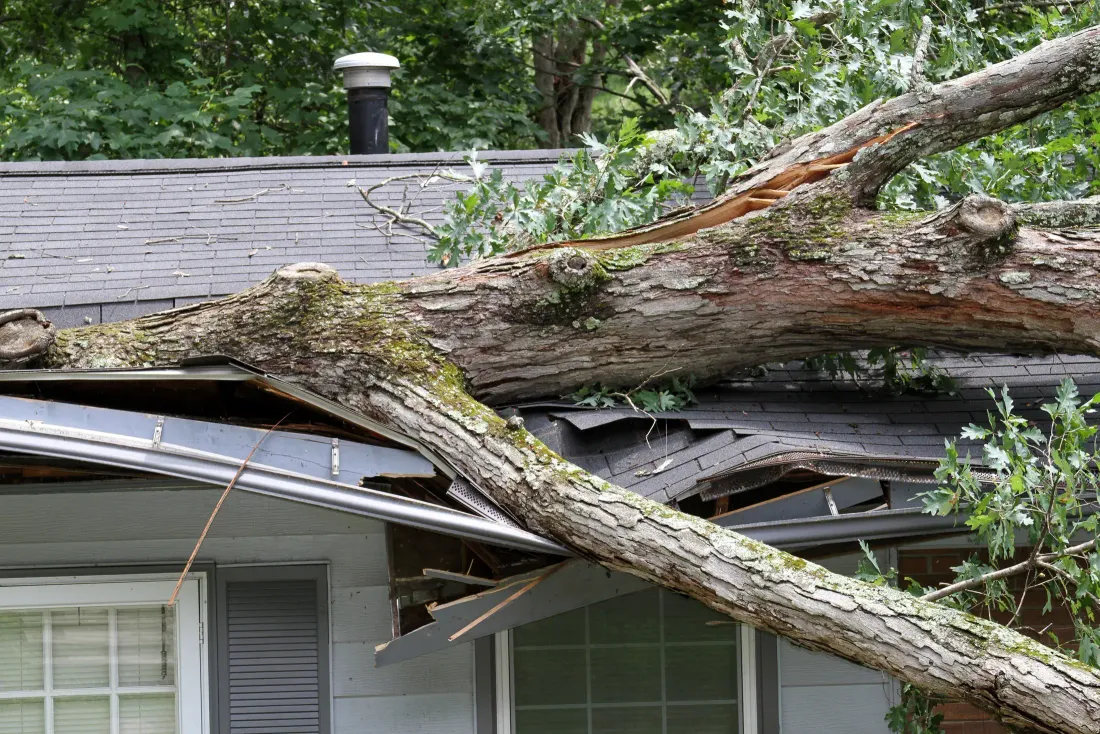
- Tree or large limb on the roof, through a window, or on a vehicle
- Tree blocking the driveway, street, or an exit
- A trunk that shifted in the storm, or a new lean with the soil lifting at the base
- A large limb cracked and hung up directly over a walkway, patio, or play area
- A tree leaning on the neighbor's house or fence
Urgent — first available appointment
- A limb down in the yard, not touching anything that matters
- A hung-up limb over open lawn or a fence line nobody stands under
- A split visible between two main stems, tree otherwise standing straight
- Large dead sections noticed after the storm cleared the leaves
- A tree that looks "different" but hasn't moved (see the warning-signs guide)
When in doubt, describe it to a provider on the phone. A good one will tell you honestly whether it can wait — they'd rather do the job in daylight too.
What to do before the crew arrives
None of these steps involve a saw. The point is to keep people safe, preserve your insurance position, and make the crew's job — and your bill — smaller.
-
Get people and pets away from it
Clear the area under and around the tree, including inside rooms directly beneath a limb that is on the roof. A partially failed tree or limb can finish failing without any wind.
-
If any part touches a wire, call your electric utility first
Treat every downed or contacted line as live. Do not touch the tree, the line, a fence or vehicle the line is touching, or standing water near it. Your utility, not a tree company, has to make a line safe before anyone works near it.
-
Photograph everything before anything moves
Wide shots of the tree and what it hit, close-ups of the break, the roof, the fence, the car. Your insurer will want them, and so will the provider giving you a price.
-
Call your homeowner's insurer if a structure is damaged
Coverage for tree damage and removal varies by policy. Ask what is covered, whether they need to approve a provider, and whether they want to inspect before removal.
-
Cover openings if you can do it safely from the ground
A tarp over a roof hole or broken window keeps rain out. Do not get on a roof with a tree or limb still resting on it, and do not climb a ladder against a damaged tree.
-
Leave the cutting to the crew
A limb or trunk under load is spring-loaded. Cutting it can release that energy toward you, and a tree that is resting on a structure can shift when weight comes off. This is the one job in tree care that isn't a chainsaw-and-a-weekend project.
Storm damage in the Central Valley: what fails and why
Modesto's tree emergencies cluster around winter storms, when saturated soil and wind arrive together. Wet ground holds roots less firmly, so a tree that stood through a dry windstorm can go over in a wetter one at lower wind speeds. The same storms load the canopy: a tree still in leaf carries far more wind than a bare one, which is why early-season storms before leaf drop, and evergreens any time, do a disproportionate share of the damage.
Three failure patterns account for most of the calls. Root-plate failure: the whole tree tips, and you'll see a mound of lifted soil and roots on the upwind side. Stem failure: one of two co-dominant trunks tears away at the junction, often taking a strip of the other stem with it. Limb failure: a large lateral limb breaks at the trunk, or cracks partway and hangs. The first two usually mean the tree comes out; the third often means a trim and an assessment of what's left. Which one you have is worth describing when you call, because it changes the equipment a crew brings.
Dead wood also comes down in summer heat on perfectly calm days, which is why a tree with a lot of dead canopy is worth dealing with before the season rather than after it fails — see the five-minute self-check.
What emergency tree work costs in Modesto
We publish only figures we've been able to verify locally, and for emergency work there's one: emergency trimming in Modesto is commonly billed at around ~$250/hour. Full emergency removals are almost always priced on site, because a tree on a roof is a rigging and crane question before it's a size question, and no one can quote that from a phone description.
For scale, a normal-appointment removal in Modesto typically runs $535–$726, and trees over 60 ft run $1,000+ — an emergency version of the same tree costs more than that, sometimes substantially, because of after-hours crew, urgency, and the complexity of working around a damaged structure. Stump grinding, at $75–$1,000, is separate and can usually wait for a normal appointment even when the removal couldn't. The full breakdown of what drives the number is on the Modesto tree removal cost page.
Two ways to keep an emergency bill down: get the insurance call made before the crew arrives so the work can be scoped to what's covered, and separate "make it safe tonight" from "finish the job." A crew can often remove the limb from the roof and tarp the hole in the evening and come back in daylight for the rest at a normal rate.
Permits and street trees in an emergency
A tree on your own lot can generally be dealt with by a provider you hire, based on what the City of Modesto currently publishes — with the caveat, explained on the permit page, that we haven't been able to confirm the private-tree question either way. A City street tree — the one in the parking strip in front of your house — is a different case: it belongs to the City, and the Community Forestry Division (209-342-2253, general line 209-577-5200) is who to contact, even if it's down across your driveway. In Ceres, Public Works (209-538-5732) fields street-tree questions. In Turlock, the Street Tree Permit requirement is expressly waived only when the tree is an immediate threat to public safety — which a tree down across a sidewalk usually is, but which is Turlock's call to make, not yours.
The truck that shows up uninvited
After a big storm, crews drive neighborhoods looking for damage. Some are established local companies picking up work; some are not. The differences are the same ones on the cost page's vetting list, compressed: ask for the CSLB license number and check it on your phone at cslb.ca.gov while they wait; ask for proof of insurance; get the price and the scope in writing, even a text message; don't pay in full up front. The pressure to decide right now is the thing to be suspicious of. A tree that's already on the ground isn't going anywhere.
Ready for help? Tell us what happened and where, and we'll match you with a local provider who serves your part of Stanislaus County. Several advertise 24/7 response; if it's after hours, say so in the form.