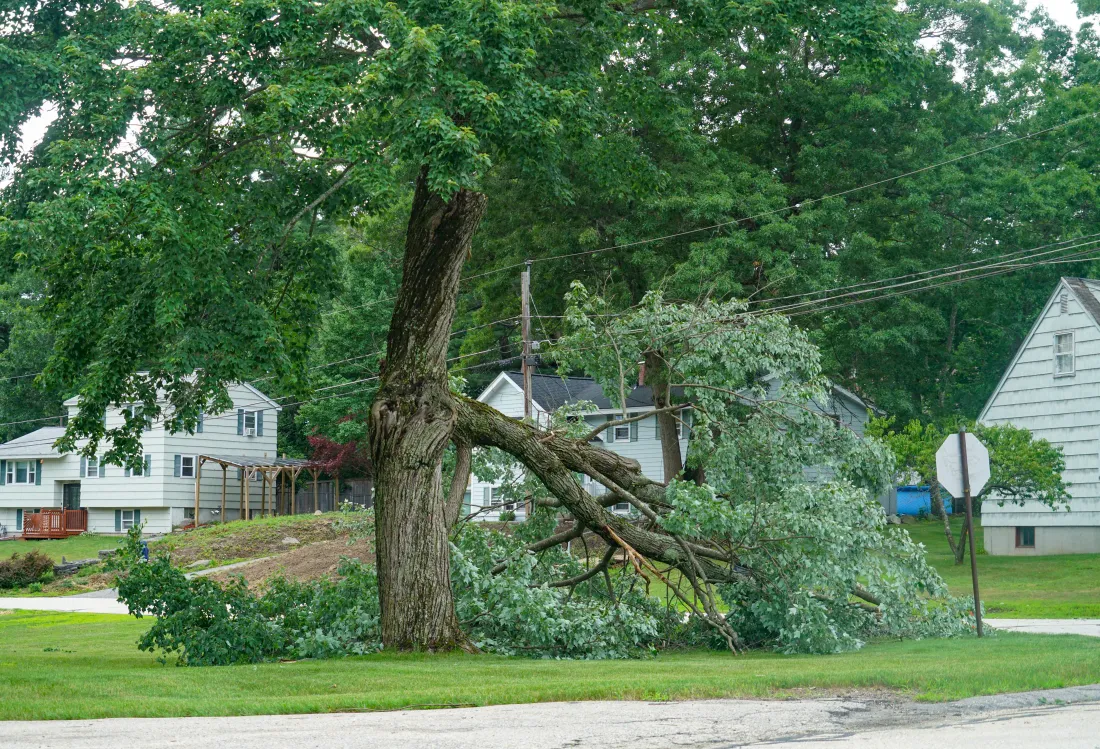
Trees don't fail without warning very often. What usually happens is that a homeowner notices something small — one bare limb, a mushroom at the base, a trunk that seems to sit a little differently than it used to — and isn't sure whether it matters. This page walks through the same four symptom groups as the field reference on our homepage, in more depth, so you can describe what you're seeing and decide how urgently to act.
One honest framing up front: nothing on this page is a diagnosis. Modesto Tree Care is a matching service, not a tree company, and we don't employ arborists. Every section below ends with the same advice — get someone who climbs trees for a living to look at yours in person. What we can do is help you know what to look for and what to tell them.
Dead or bare branches
Sections of the canopy with no leaves, or bark that peels off in sheets.
Dormant, stressed, or dead?
The first question is seasonal. Deciduous trees in the Central Valley are supposed to be bare through the winter, so a leafless tree in December tells you nothing. The signal is a tree that stays bare, or stays partly bare, once everything around it has leafed out — or one that drops leaves in the middle of summer while its neighbors don't.
The scratch test settles most of it. Pick a pencil-thick twig and scrape a small patch of bark with a thumbnail. Green and slightly moist underneath means the twig is alive; dry, brown, and brittle means it isn't. Do this in several places, because a tree can be dead on one side (often the side that takes the afternoon sun, or the side over a paved surface) and alive on the other. If every twig you test is dead and the small branches snap rather than bend, the tree is very likely gone.
What a dead section means for the rest of the tree
A single dead limb on an otherwise healthy tree is normal — trees shed branches they can't support. A dead limb is still a hazard if it hangs over something you care about, but it usually means "trim," not "remove." The picture changes when the dead wood is a large fraction of the canopy, when it is concentrated in the top of the tree (dieback from the crown down is a classic sign of root or trunk trouble), or when it comes with bark sloughing off in sheets to reveal dry, discolored wood underneath. At that point the tree is usually past what trimming can fix, and the question becomes how and when to take it down rather than whether.
Why dead wood matters more near a house
Dead wood dries, and dry wood is brittle. A limb that would have flexed in a wind gust while alive can snap cleanly once dead, and it doesn't need a storm to do it — dead limbs come down on calm days, often in summer heat. The practical rule providers use: if a dead limb can reach a roof, a driveway, a sidewalk, a fence line, a play area, or the street when it falls, it should be dealt with soon. If it can only reach open lawn, you have more time.
What to tell a provider: roughly what share of the canopy is dead, whether the dead wood is high or low, what it hangs over, and whether the bark is loose. See the Modesto tree removal cost guide for what those answers do to the price.
Leaning trunk or exposed roots
A trunk that leans more than it used to, or soil lifting near the base.
The lean that matters is the new one
Plenty of healthy trees lean. A tree that grew toward light from the day it was planted has built its trunk and roots around that lean, and it is no more likely to fall than a straight one. What providers treat as urgent is change: a lean that wasn't there last year, a lean that got worse after a windstorm or a week of heavy rain, or a lean paired with anything happening at ground level.
The ground is where to look. When a tree starts to tip, the root plate on the side opposite the lean begins to lift. You'll see soil that has cracked in an arc around the base, turf that has heaved up like a low bump, or a gap opening between the soil and the trunk on one side. Fresh exposed roots that used to be buried are the same signal. This combination — a new lean plus ground movement — is one of the few things on this page that providers will tell you not to wait on, because a tree whose root plate is moving can go over without any further warning.
Exposed roots that are not an emergency
Surface roots are common on mature trees in Modesto yards, especially where lawn irrigation keeps the top few inches of soil wet and roots have no reason to go deeper, or where a root has run into a sidewalk, driveway, or foundation. A big root snaking across the lawn is a tripping hazard and can be a hardscape problem, but by itself it doesn't mean the tree is unstable. The difference is whether the roots are moving. Roots that have always been visible and stay put are a landscaping question; roots that are newly exposed because the soil around them has lifted are a stability question.
Damaged or cut roots
If there has been recent trenching, a new driveway or patio, a sewer line repair, or a neighbor's construction near the tree, and the tree started leaning or thinning afterward, say so. Cutting a large share of the roots on one side can leave a tree standing for months or years before it shows stress, and it tells a provider a lot about what they're likely to find.
What to tell a provider: when the lean started, which way it leans, what's in the fall path, and whether the ground at the base has moved. If the answer to the last one is yes, say that first.
Storm or wind damage
Split limbs, a cracked trunk, or a tree that shifted during a storm.
The damage you can't see from the ground
A limb that comes all the way down in a storm is inconvenient but honest — you can see it, and you know where it is. The dangerous ones are the limbs that crack partway through and stay up. Climbers call a broken limb hung up in the canopy a "widowmaker" for a reason: it can hold for weeks, then drop on a still afternoon with no wind at all. After any significant wind event, look up into the canopy from several angles for limbs that are hanging at an odd angle, resting on other limbs, or showing pale, freshly split wood.
Trunk splits and co-dominant stems
Many trees grow two or more main stems from roughly the same point. That junction is the weakest structural point on the tree, especially where the bark is pinched between the stems rather than forming a solid ridge. Wind loads pry those stems apart. If you see a vertical crack running down from where the stems meet, a seam that has opened up, or one stem that now sits at a different angle from its twin, the tree has a structural failure in progress. This is a same-week call regardless of what the rest of the tree looks like, because a split trunk doesn't heal — it only gets wider.
A tree that moved
If a tree visibly shifted during a storm — it sits at a different angle, the ground on one side heaved, or it is now resting against a structure or another tree — treat it the same as No. 02's new-lean-plus-ground-movement case. It may stand for a long time or it may not, and there is no way to tell from the lawn.
For what counts as a true emergency versus what can wait for a normal appointment, and what to do before a crew arrives, see the Modesto emergency tree removal page. The short version: anything touching a power line is the utility's call first, not a tree company's; anything on a roof or blocking a driveway is urgent; a hung-up limb over open lawn is a prompt appointment, not a 2 a.m. one.
Not sure — general warning signs
Something looks off but you're not sure which category it fits.
Fungus and mushrooms
Mushrooms in the lawn after rain are usually just decomposing organic matter and mean nothing about the tree. Mushrooms or shelf-like fungal brackets growing from the trunk itself, from the flare where the trunk meets the ground, or from the major roots are different: they are the fruiting bodies of a fungus that is already living inside the wood, and by the time you see them the decay has usually been under way for a while. A tree can look completely healthy in the canopy while its base is hollowing out. Note where the fungus is, photograph it, and mention it early in the call.
Thinning over more than one season
A canopy that is noticeably thinner than it was two summers ago — smaller leaves, more sky visible through it, less new growth at the tips — is a tree under long-term stress. Common causes in Central Valley yards include changes in watering (a lawn converted to drip or removed entirely, a broken irrigation line, a new drought-tolerant landscape around a tree that grew up on lawn water), soil compaction from vehicles or construction, and root damage. This one is rarely urgent, but it's worth an assessment because the fixes are cheapest early.
Cavities, cracks, and soft spots
A hollow in the trunk isn't automatically a problem — trees can stand for decades with a cavity as long as enough sound wood surrounds it. What matters is proportion, and a provider can probe or sound the trunk to estimate it. Soft, spongy, or crumbling wood you can push a screwdriver into; sawdust-like material collecting at the base; small, neat holes in the bark with pitch or frass around them (a boring-insect signature); and bark that lifts off in plates are all worth reporting.
"It just looks different"
Homeowners are usually right when they say this. You look at the tree every day, and a change that's too gradual to name is still a change. None of the signs in this section alone confirm a tree needs to come down — most don't — but together they are exactly the kind of thing an on-site look sorts out in ten minutes.
A five-minute self-check before you call
You don't need to know what's wrong. You need to be able to describe it. This walk-around takes a few minutes and makes every conversation with a provider shorter and more accurate.
-
Walk the drip line
Circle the tree at the edge of its canopy and look at the ground. Note any mushrooms, shelf fungus, sawdust-like frass, or soil that is cracked or heaved on one side.
-
Check the base and trunk
Look at where the trunk meets the soil for cavities, soft or spongy wood, peeling bark, or a trunk that flares oddly. Then scan the trunk for vertical cracks, seams, or a split where two main stems meet.
-
Look up at the canopy
Compare the tree to itself: are there whole sections with no leaves while the rest is in leaf? Any limbs hanging, cracked partway through, or resting on another limb, roof, or wire? Note which side of the tree, and roughly how large the dead section is.
-
Compare the lean
Stand back and sight the trunk against a fence post, wall, or the house. A lean the tree has always had is usually fine; a lean that is new, or that got worse after wind or rain, is not.
-
Photograph and write it down
Take wide shots and close-ups of anything you found, and note when you first noticed it. A provider can give a far more useful estimate over the phone when you can say "one dead limb over the driveway, about as thick as my arm, first noticed in July."
Do this from the ground. Don't climb, don't use a ladder against a tree you think may be unstable, and stay well clear of anything touching a power line.
How urgent is it?
| What you're seeing | Usually means | Timeline |
|---|---|---|
| Limb on a power line or service drop | Utility issue first | Now — call your electric utility, stay away |
| New lean + soil lifting at the base | Root plate moving | This week, sooner if it can hit a structure |
| Split trunk / opened seam between stems | Structural failure in progress | This week |
| Hung-up broken limb over roof, driveway, or sidewalk | Drop hazard | This week |
| Fungus growing from trunk or root flare | Internal decay | Prompt assessment |
| Large dead section in growing season | Dieback; possibly past saving | Prompt assessment |
| One dead limb over open lawn | Routine trim | Next scheduled appointment |
| Thinning canopy over 2+ seasons | Long-term stress | Assessment when convenient |
| Old, stable lean; long-visible surface roots | Normal for a mature tree | Monitor |
One more thing: is it even your tree?
In Modesto, the tree in the parking strip between the sidewalk and the street in front of your house is usually a City street tree, and removal requests for those go through the City of Modesto Community Forestry Division (209-342-2253), not a private provider you hire yourself — though the City's program makes the property owner responsible for the cost. Ceres and Turlock run their own separate street-tree processes. If the tree you're worried about fronts the street, read the Modesto tree removal permit page before calling anyone.
Ready for an on-site look? Tell us what you found in the self-check and we'll match you with a local provider who serves your part of Stanislaus County.